Custom Kitchen Cabinets: OEM, ODM and Made-to-Order Explained
- Share
- Issue Time
- Nov 17,2026
Summary
A trade buyer's guide to the three ways custom kitchen cabinets are actually made: what OEM, ODM and made-to-order each transfer to you, what they cost in tooling and MOQ, how to verify a factory, and which model fits a first container.
FAQ & Buying Guides
Direct answer
OEM means a factory builds kitchen cabinets to your drawings, under your brand. ODM means you adapt a proven range the factory already owns. Made-to-order means a standard carcass resized to your dimensions with your door style and interior. All three are custom kitchen cabinets. What changes is who owns the design, who pays for tooling, the minimum order and the lead time.
Most first RFQs for custom cabinets for kitchen projects arrive with a plan, a photograph and all three words in the same paragraph. The supplier answers the one you typed, and the quote that comes back can differ from a competitor's by more than double — not because one factory is expensive, but because the two quotes describe two different products with two different owners of the design.
This guide separates the three models the way a sourcing manager has to: by design ownership, tooling responsibility, minimum order, compliance paperwork and calendar time. Public trade and regulatory data is cited where it exists; where it does not, the figure is labelled as our own production record so you can tell the difference. If you only want to see the product range first, start from our custom kitchen cabinets collection.
What Do OEM, ODM and Made-to-Order Mean for Custom Kitchen Cabinets?
The three labels describe three different starting points, not three quality levels. Everything after the starting point — price, minimum order, lead time, who carries design liability — follows from that choice.
OEM
The design is yours. You supply drawings, door profiles, finish references, packaging artwork and brand marks. The factory supplies process capability: panel optimisation, edge banding, finishing, hardware assembly, inspection and export packing. The product is yours to register, certify and sell.
ODM
The design is the factory's. You choose from an existing platform of door styles, carcass sizes and interior layouts, then adapt colour, size increments and fittings within what that platform allows. Engineering and tooling already exist, so the route to a first container is shorter.
Made-to-order
The carcass is a standard platform, the dimensions are not. Widths and heights move in fixed increments, the door style comes from a catalogue, and the interior is configured to the space. It sits between stock and full custom, and it is what most renovation and contract work actually needs.
Importers who sell custom made kitchen cabinets under their own label usually run OEM or ODM; a project buyer who needs one kitchen usually runs made-to-order. The supply base behind all three models is not a niche. UN Comtrade records China exporting US$832.2 million of wooden kitchen furniture under HS 9403.40 in 2024 — 16.1 million units and 329,182 tonnes.[1] The destination split matters more than the total, because it tells you which compliance regimes your own order will be measured against.
China's wooden kitchen furniture exports, 2024 — top destinations
Source: UN Comtrade, HS 9403.40, China as reporter, calendar year 2024. Bars are scaled to the largest destination. Full-year mirror data may differ from national customs figures.
OEM Kitchen Cabinets: Who Owns the Design, Mold and Packaging?
In an OEM kitchen cabinet programme the buyer owns the design intent and the factory owns the process. That split sounds clean until the first dispute, which is almost always about one of five artefacts. Pin all five in the purchase contract, not in email.
The drawings and the 3D files decide who can reproduce the kitchen in three years. Specify that as-built production drawings, the panel cutting list and the 3D model are handed over on final payment, in a format you can open without the factory's software.
For bespoke kitchen cabinets the door profile is the second artefact. A bespoke raised panel or a curved rail needs knives or a mould. Ask three questions: who pays for the tooling, where it is stored between orders, and whether it can be shipped to a second supplier if the relationship ends. A factory that will not answer the third question is telling you something.
The sample door is the third. Treat it as a golden sample — signed, dated, kept by both sides, and referenced in the specification. Colour is the most common defect in cabinetry claims, and a signed sample is the only defence that survives a container of 400 doors.
The carton is the fourth. Branded packaging carries a printing plate or a die-cut cost, and it usually has a minimum run. If your brand mark, barcode and language variants are on the carton, say who owns the plate and who stores it.
The compliance paperwork is the fifth, and it is the one buyers most often get wrong. A TSCA Title VI or CARB ATCM label is issued against the panel supplier's certified product, not against your brand. You can specify compliant board; you cannot manufacture the certificate.
What OEM does not transfer is design liability. If the drawing specifies a 19 mm carcass with a 600 mm drawer box on 45 kg runners, the factory will build exactly that, and the load rating remains your responsibility. The useful question in an OEM audit is not "can you make this" but "what would you change, and what does that change cost".
ODM Kitchen Cabinets: A Faster Start With Clear Limits
An ODM programme starts from a range that is already engineered, jigged and priced. That is the entire commercial advantage: no tooling amortisation, no first-article delay, and a specification you can quote from on the first call. The limit is equally fixed — you are adapting a platform, not commissioning a new one.
What usually can change inside an ODM platform: door style within the range, colour and sheen, width and height increments, drawer and internal layout, handle and hinge brand if it is on the approved list, and the interior fittings the carcass is already drilled for. What usually cannot: carcass depth beyond the platform, structural rework, unusual radii, and any profile that needs new tooling — at which point you have moved into OEM whether you intended to or not.
Two commercial points decide whether ODM works for you. The first is exclusivity: unless it is negotiated, the factory can sell the same range to another buyer in your market. The second is certification: the range's test reports belong to the factory and its panel suppliers, so your importer of record is relying on documents you do not control. Neither is a reason to avoid ODM; both are reasons to write them down. If you want to see what an adapted platform looks like in practice, our modern kitchen cabinets range is built this way.
Made-to-Order Kitchen Cabinets vs Full Custom: What Actually Changes
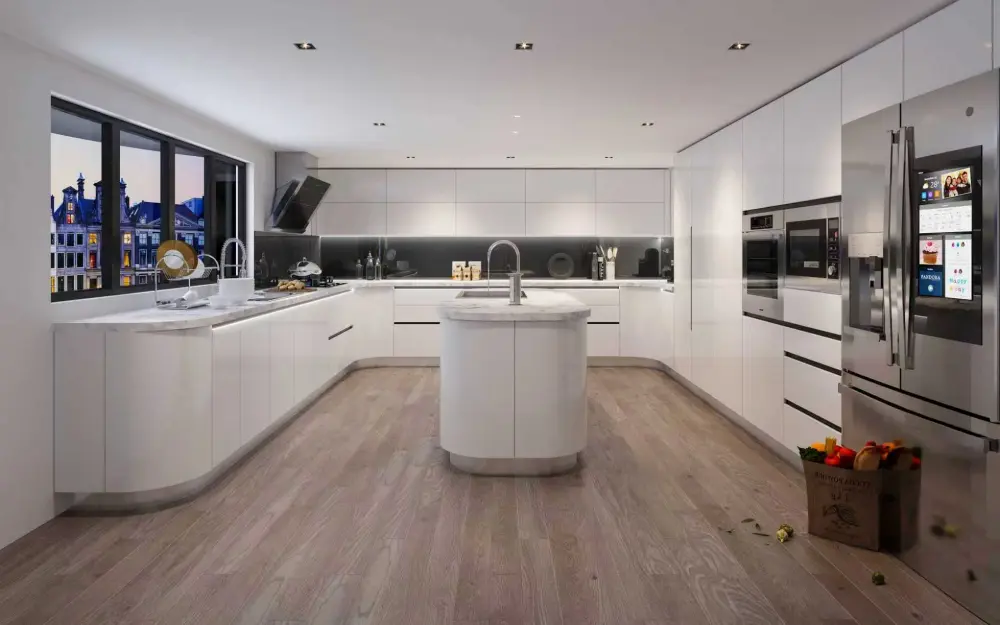
Made-to-order keeps the carcass standard and moves the dimensions. Full custom moves the carcass itself. A kitchen cabinet custom made from a standard carcass still has to fit the room, which is why the increments matter. In practice that means three differences you can price.
First, increments. A made-to-order run resizes in fixed steps — commonly 50 mm on width and 100 mm on height — because the drilling pattern and the hinge positions are fixed. A full-custom run redraws those positions per unit. Second, the door. Made-to-order draws from an existing profile catalogue; full custom can require new knives, which is a tooling line item and a lead-time line item. Third, the interface with the building. Curved walls, sloped ceilings, integrated appliance panels and radiused islands — the usual brief for luxury custom kitchen cabinets — are where full custom earns its price, because they are resolved in engineering rather than absorbed by filler panels.
For importers and distributors, made-to-order is usually the better commercial product: it is repeatable, it is quotable from a price list, and the reorder is the same product. For a single high-value residence, full custom is usually the only honest answer.
OEM, ODM or Made-to-Order: Comparison Table for Trade Buyers
Read the table by column, not by row. The column where the buyer carries the most obligations is the model you are actually choosing.
| Decision point | OEM | ODM | Made-to-order |
|---|---|---|---|
| Design ownership | Buyer — drawings, 3D files, door profiles | Factory platform; buyer adapts | Shared: factory carcass, buyer dimensions and door |
| Tooling | New knives or moulds usually required, paid by buyer | None; profiles already exist | Existing profiles only |
| Minimum order | Highest — a full container per door style and finish | Lower — one 20ft container, mixed styles | Lowest — one kitchen or one room |
| Development cost | Drawings, sample and packaging plate quoted separately | Sample charged, normally credited against the order | None |
| Time to first container | Longest: drawing, tooling, sample approval, production | Shorter: range is already engineered | Shortest of the three |
| Reorder behaviour | Identical, provided tooling is stored and owned | Identical, subject to platform availability | Identical, subject to standard increments |
| Branding and packaging | Fully yours — cartons, labels, manuals, barcodes | Yours, usually from a factory template | Yours or neutral |
| Compliance documents | Panel supplier's certificates; importer holds the entry | Same, and held by the factory | Same |
| Design liability | Buyer | Shared — factory engineering, buyer fit | Factory platform, buyer dimensions |
| Best fit | Retail brands, distributors with a catalogue, multi-site programmes | New importers, showrooms, buyers testing a market | Renovation projects, contract fit-outs, builders |
If your real alternative is stock or ready-to-assemble rather than another factory programme, the boundary sits somewhere else — our comparison of custom cabinets vs RTA cabinets covers where stock ends and custom begins.
What MOQ Should You Expect From a Custom Kitchen Cabinet Manufacturer?
Minimum order is set by what the factory has to switch, not by what it wants to sell. A new door profile needs a tooling run and a colour batch; a new carton needs a print run; an existing platform needs neither. The ranges below are what buyers typically see from Chinese cabinetry exporters, and they move with finish, profile and season — treat them as a negotiation baseline rather than a promise.
| Model | Typical minimum | Typical first order | What sets the number |
|---|---|---|---|
| OEM | One full container per door style and finish | 1 × 40ft container | Tooling run, colour batching, packaging print run |
| ODM | One 20ft container, styles may be mixed | 1 × 20ft container | Platform stock and finish minimums |
| Made-to-order | One kitchen or one room | 1 project | Cutting-list efficiency per panel |
If a supplier offers five sets on an OEM programme, ask what happens to the tooling cost at five, and who owns the knives afterwards. The answer usually explains why the price per set is higher than the container quote you were hoping to compare it with.
Freight is the other fixed cost in the first order, and it is priced per container, not per cabinet. Drewry's World Container Index stood at US$4,305 per 40ft container on 12 November 2026, with Shanghai–Los Angeles at US$7,416 and Shanghai–New York at US$9,020.[3] A 40ft high-cube holds roughly 68 m³ of usable volume, so consolidating a whole apartment or a full showroom into one loading is usually worth more than a percentage point on the unit price.
Container freight, week of 12 November 2026 — US$ per 40ft
Source: Drewry World Container Index, assessment of 12 November 2026. Spot rates move weekly and exclude inland haulage and duties.
How to Verify a Factory Before You Commit to a Custom Kitchen Cabinet Program
A showroom proves that a factory can build one good kitchen. It says nothing about the four hundredth. Verification is a walk through the process, in the order the panels take it.
1. Board certificates, not board claims. Ask for the panel supplier's TSCA Title VI or CARB ATCM test report and the label that goes on the finished good. The US limits are specific and testable, and they apply to the cabinet as an article, not to the raw board in isolation.
2. The cutting and edge-banding line. Nesting CNC and laser or hot-air edge banding decide whether a door survives a humid kitchen. Look at the seam, not the machine.
3. Finishing. A spray booth and a conveyor line are different businesses. Ask how many coats, what cure time, and how colour is matched between batches — this is where a reorder stops matching the first container.
4. Inspection gates. Dimensional checks against the drawing, hardware function tests, and a full accessory count before packing. Ask to see the inspection record for the last project, not a blank template.
5. Packing and loading. Corner protection, carton drop test, and photographs of the actual container loading. Damage in transit is decided at packing, not at the port.
The US formaldehyde limits that a kitchen cabinet programme has to meet are fixed by regulation, and they are the easiest thing to verify because the numbers are public:
| Composite wood product | Limit | Test method |
|---|---|---|
| Hardwood plywood, veneer or composite core | 0.05 ppm | ASTM E1333-14 |
| Particleboard | 0.09 ppm | ASTM E1333-14 |
| Medium-density fiberboard | 0.11 ppm | ASTM E1333-14 |
| Thin MDF (≤ 8 mm) | 0.13 ppm | ASTM E1333-14 |
Limits under 40 CFR 770.10 (TSCA Title VI). Since 22 March 2019 composite wood products and finished goods containing them must be labelled TSCA Title VI compliant; the CARB ATCM Phase II label was the accepted predecessor.[2]
Two more checks cost nothing and catch most problems. First, order a sample door and keep it signed as the reference; then compare the production door against it under the same light. Second, watch the panel material, not the finish — a lacquered MDF door and a lacquered plywood door look identical on the front and behave differently after two humid summers. Our comparison of plywood, MDF and particle board cabinets covers the substrate question in detail, and the stage-by-stage production timeline explains where each of these checks sits in the calendar.
Start Your Custom Kitchen Cabinet Project With ZoneIdeal
Whichever model fits your market, the decision is only as good as the drawings and the specification behind it. A one-page brief — room list, target market, door style direction, finish, hardware preference, quantity and destination port — is enough for us to tell you which model you actually need, and to say so before you commit to tooling.
Send that brief to our team through the contact page and you will get a model recommendation and a preliminary quotation within 48 hours, based on your list rather than a catalogue page. If you want to see how the design, sampling and production stages are run first, the custom cabinet services page sets out the sequence from drawing to loading.
Ready to compare models on your own project?
Send your room list, door style and destination port. We will reply with the model that fits, the tooling position if any, and a preliminary quotation — contact ZoneIdeal here.
Frequently Asked Questions
Do I need to supply my own drawings for OEM kitchen cabinets?
You need to supply design intent, not production drawings. A dimensioned plan, elevations, a door profile reference and a finish sample are enough to start; the factory converts them into a cutting list and a 3D model for your approval. What you must insist on is that those production drawings and the cutting list are handed to you on final payment, in an open format. Without them, the next order — from this factory or another — starts from zero.
Can I change only the doors on an ODM range?
Usually yes, as long as the new door sits inside the platform's thickness and hinge drilling. Changing the door style alone is the cheapest way to differentiate a range for your market. Changing thickness or profile family is not a door change — it is a tooling change, and it moves the order into OEM terms with an OEM minimum.
What MOQ should I expect for made-to-order cabinets?
One kitchen or one room is realistic, because the carcass platform already exists and only the cutting list changes. The practical floor is set by freight and by finish minimums rather than by the factory: a single kitchen still pays for a container or shares one, and a bespoke paint colour may carry a batch minimum. Ask for the price at one kitchen and at one container, then look at the difference per unit.
Who owns the door profile mould after an OEM order ends?
Whoever the contract says, which is why the contract has to say it. If you paid for the tooling, you should own it and be able to move it; if the factory amortised it into the unit price, ownership usually stays with the factory and your reorder depends on their storage. Either arrangement can work. What does not work is leaving the question unanswered until you want to change supplier.
Whose name goes on the TSCA Title VI label?
The label identifies the finished good as compliant and traces it to the panel producer's certification. It is issued against the certified composite wood product, not against the cabinet brand, so an OEM buyer cannot create one and does not need to. Your obligation as importer is to keep the records and the label on the article; the factory's obligation is to buy certified board and prove it.
References
- United Nations Comtrade Database — HS 9403.40, wooden furniture of a kind used in kitchens; China as reporter, exports, calendar year 2024 (accessed 17 November 2026).
- 40 CFR 770.10 — Formaldehyde emission standards, US Environmental Protection Agency, TSCA Title VI (accessed 17 November 2026).
- Drewry World Container Index, assessment of 12 November 2026 (accessed 17 November 2026).